Eel Fishing Tackle
Eel Fishing Tackle
Eel fishing is a popular activity among fishing enthusiasts, especially during the summer months when these fish are more active. Proper tackle and equipment are crucial for a successful eel fishing experience. This guide will provide a detailed overview of the necessary tackle and equipment for eel fishing.
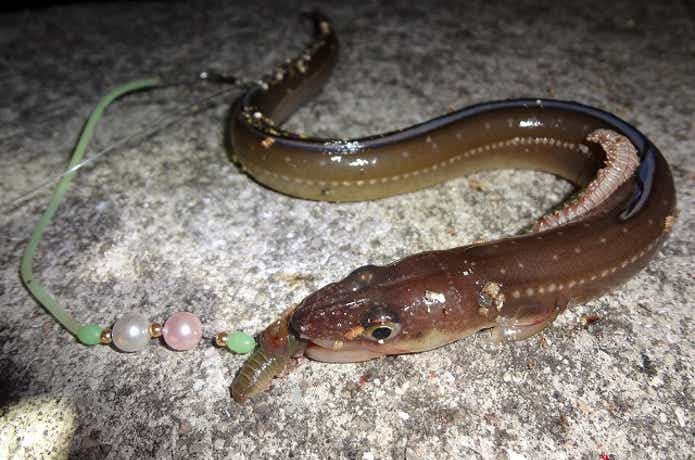
Basic Eel Fishing Tackle
The tackle used for eel fishing varies depending on the fishing location and method. Here is an overview of the essential tackle and equipment for eel fishing:
1. Fishing Rod
Tetrapod Fishing: For this method, a fishing rod of approximately 4.5 meters in length is typically used. For surfcasting, rods ranging from 2.7 meters to 4.5 meters are common, and they should be strong enough to handle weights of 10 to 20 ounces. Therefore, a rod with a sturdy backbone is preferred. Surfcasters often use rods around 6 meters in length for specialized surfcasting.
Boat Fishing Tackle: When fishing from a boat, a rod of 2.7 to 3 meters in length, with a medium-heavy power, is suitable. It should not be overly bulky but should have enough strength for effective use.
2. Reel
- Tetrapod Fishing: A reel of at least 3000 size is recommended. For surfcasting, reels between 4000 and 6000 size are used, while boat fishing typically requires reels around 4000 size. A medium-sized spinning reel is generally used, and since heavier lines (5 or more pounds) are employed, the reel's size is important. Larger reels offer better casting distance and faster retrieval.
3. Line
Tetrapod Fishing: For the main line, use nylon line of 12 to 14 pounds, with a leader line of 10 pounds.
Surfcasting Tackle: The main line should be nylon of 6 to 8 pounds, with a support line of 6 to 8 pounds and a leader line of 4 to 5 pounds.
Boat Fishing Tackle: Use a main line of nylon 5 to 6 pounds, with a leader line of 3 pounds.
4. Hooks
Tetrapod Fishing: Use size 8 hooks for sea bream.
Surfcasting Tackle: Long-shank hooks in sizes 11 to 14, sea bream hooks in sizes 5 to 7, and blowfly hooks in sizes 12 to 15 are recommended.
Boat Fishing Tackle: Long-shank hooks in sizes 11 to 14, sea bream hooks in sizes 5 to 7, and blowfly hooks in sizes 12 to 15 are suitable.
5. Handline
A handline is used instead of a reel for boat fishing. It involves winding the line around a spool by hand and casting and retrieving manually. While it can be less convenient and requires the line to be stored on deck, it is inexpensive and provides clear feedback on bites through the line.
Eel Fishing Tackle Combinations
The combination of tackle and equipment for eel fishing varies based on the method and environment. Here are some effective tackle combinations for eel fishing:
1. Chemical Light & Bells
Since eel fishing is typically done at night, attaching a chemical light to the tip of the rod helps in detecting movements more clearly. Bells can also be used as an alternative to chemical lights.
2. Rocket Rigs & Sinker Assemblies
Rocket rigs and sinker assemblies are pre-made for convenience. They allow for easy casting and require occasional retrieval to attract eels. Simply cast the rig, occasionally retrieve it, and wait for a bite.
3. Boat Fishing Rigs
Although primarily used for flatfish, boat fishing rigs are also effective for eel fishing. The rig involves lowering and raising the tackle vertically to attract eels.
4. Bait
Ragworm: Inexpensive and commonly used. Long ragworms should be cut into pieces as eels tend to nibble them off rather than hook them if they are too long. Alternatively, drying the bait for a couple of hours can improve effectiveness.
Sandworm: Although more expensive, sandworms are highly effective. To avoid excessive consumption, they should be dried or salted for a couple of hours to toughen them.
Mackerel Flesh: Effective for close-range casting or tetrapod fishing. Mackerel flesh can disappear quickly (within 10 minutes) even when dried or salted, so frequent bait changes are necessary. Despite the inconvenience, its effectiveness is significant when eels are present.
Conclusion
Proper tackle and equipment selection are crucial for successful eel fishing. By choosing the right rod, reel, line, hooks, and bait, and by using effective combinations and methods, anglers can increase their chances of a successful fishing experience. Use this guide to prepare for eel fishing and enjoy a productive outing.
Keywords: eel fishing tackle, surfcasting, boat fishing tackle, fishing rod, reel, handline, bait, ragworm, sandworm, mackerel flesh


댓글
댓글 쓰기